
Abstract
Identity puzzles like the Ship of Theseus turn on two questions, not one. The first is a question of ground: in virtue of what does an object remain the same—the persistence of its matter, or the persistence of its form? The second is a question of cardinality: how many bearers is the situation allowed—one name with one referent, one region with one object, or more? This paper argues that the two questions are independent—neither answer forces the other—and that the tradition has silently treated them as one, welding a choice of ground to a matching cardinality without noticing the second choice was a choice. I defend the independence directly (all four combinations of {matter, form} × {one bearer, many} are coherent, occupied, and rationally adoptable—not ruled out by the puzzle itself, which is the modest status the argument needs) and then show it doing work: it explains why the canonical versions of the puzzle are differently structured rather than the same problem at different difficulties. Plutarch’s gradual-replacement ship is a dispute over the predication of identity to one object; Hobbes’s reassembly ship is a dispute over the reference of one name across two objects, and becomes a flat contradiction only under a single-bearer assignment that neither criterion supplies. The same joint reappears one level down in the statue and the clay, where the free parameter is not a name’s reference but the count of objects in a region (monism versus the constitution view). With the two dimensions separated, the standard “dissolution” of the Ship of Theseus is revealed as the prime exhibit of the conflation: fixing the criterion answers the ground question and, in the two-candidate cases, silently fixes cardinality as well, then presents two answers as one. That conflation—not the puzzle—is what has lasted, and its very reasonableness is why.
I record one commitment I do not discharge: that reference-cardinality and object-cardinality are values of a single parameter rather than two structurally analogous ones (§5.3). The independence claim that does the work survives whether or not that unification holds.
1. Two questions inside one puzzle
In a dry dock in the Piraeus a shipwright stacks the planks he has been quietly saving—every timber pulled from Theseus’s ship as it rotted, one per voyage, for ten years. Out in the Aegean the ship he pulled them from is still sailing, sound, every board new. Two hulls, one name. He has not yet decided which is lying.
The reflex, on meeting this, is to ask a single question—which one is really Theseus’s ship?—and to expect a single kind of answer. The claim of this paper is that there is no single question here. There are two, and they are independent.
The first is a question of ground. In virtue of what does a thing stay the same thing over time? Two answers have been on offer since antiquity: its matter, the stuff it is made of, or its form, the continuous functional organisation that persists while the stuff is swapped out. Call these the material and formal criteria. They are rivals: each is put forward as sufficient on its own to settle whether identity holds.
The second is a question of cardinality. How many bearers is the situation allowed to have—how many things may the name “the Ship of Theseus” pick out, how many objects may occupy a single region? This question is not about what makes something the same; it is about how many candidates are in play to be the same.
The thesis is that these two questions are orthogonal: fixing an answer to one leaves the other open, and the answer to the second—not the first—decides whether the rival grounds collide or merely run in parallel. The tradition has not seen this because it has, almost without exception, fused the two: it picks a ground and helps itself to a matching cardinality in the same breath, as though the count followed from the criterion. It does not. Making the second choice visible, and showing it unforced, is the contribution.
I claim three things, in order of priority. First (§4), the two dimensions are independent: all four combinations of ground and cardinality are coherent and occupied. Second (§5), this independence explains a fact the case-by-case literature records but does not account for—that the puzzle’s versions and cousins are differently structured, not the same problem at different difficulties. Third (§6), the treatment most often praised as the model dissolution of the Ship of Theseus is in fact a compact demonstration of the conflation, and its reasonableness is exactly why the conflation has survived.
The scope is narrow. This is an account of the structure of a family of identity puzzles, not a theory of personal identity and not a verdict on which ship is “really” Theseus’s. I take no position on the latter; and—a point made precise in §2—I take no position on whether the conflict of grounds is in principle decidable. My claim is the weaker, more secure one: that these puzzles do not decide it, and that the standard treatment mistakes not deciding it for not needing to. The framework plausibly extends to other identity puzzles—psychological versus bodily continuity, fission—where ground and cardinality recur; I do not test that here, and nothing below depends on it.
2. The first dimension: ground
Watch the usual move in slow motion. You are handed a flickering object and told to stop the flicker by choosing a criterion. You choose matter: “the ship” is the timber it is composed of. The answer is now determinate—the all-new ship in the Aegean is a different ship, cleanly, no paradox. Or you choose form: “the ship” is the continuous organisation that persists through replacement of parts. Again determinate—the same ship, cleanly. Either way the flicker stops.
But notice what stopped it. There were two criteria in the room, and they assign different truth-makers to one and the same identity-claim. For “this is the same ship as Theseus’s,” the material criterion makes the truth-maker the persistence of constituents; the formal criterion makes it the persistence of organisation through the replacement of constituents. The incompatibility is not merely that both conditions obtain. It is that each is offered as sufficient in its own right to settle the identity, so the situation cannot answer to both without one being made to defer to the other. This blocks the easy thought that identity is simply overdetermined—settled twice over, by matter and form alike. It is not overdetermined, because the two would-be sufficient conditions deliver opposite verdicts: the material criterion withholds identity from the renewed ship that the formal criterion confers.
Let me bound the claim. I do not say no coherent view could combine the two. A four-dimensionalist may treat matter and form as two descriptions of one spacetime worm; a hylomorphist may treat form as a higher-level property realised in matter rather than a rival to it. Such views do not abolish the conflict; they relocate it—into a question about which description is identity-conferring, or whether the realising matter or the realised form fixes persistence. The modest version is all the argument needs: within ordinary endurantist usage, where the question is which of two purportedly sufficient truth-makers settles numerical identity over time, the material and formal criteria are prima facie incompatible. Fixing one does not adjudicate the deference between them. It selects one truth-maker and stops asking. The conflict is still in the room; you have agreed not to look at it.
This is the difference between dissolving a conflict and choosing a side in one—and a careful reader will press: why is selecting the correct criterion not simply what resolution amounts to in metaphysics? Ordinary metaphysics removes the inconsistency by argued privilege: it supplies reasons for one ground over another—parsimony, fit with our best physics, treatment of related cases—and rests its verdict on them. The standard treatment of these puzzles removes the inconsistency by stipulation: it gives no reason to prefer matter to form, and treats the disappearance of the flicker—a consequence of having fixed either—as though the choice were costless and the question closed. That is not resolution; it is theory-choice with the argument deleted and the result kept. I do not claim the conflict of grounds is in principle undecidable; that would be a metaphysical thesis I have not earned. I claim only that these puzzles do not decide it.
The plank replacement—the genuine drift—is the occasion that surfaces this conflict, not its source. The source is the pair of incompatible truth-makers, and that pair survives any amount of discipline about the criterion, because such discipline operates on the drift and the conflict is not made of drift. The deflationary rejoinder—that the whole affair is a Sorites in a hull, vagueness about the threshold proportion of replaced planks—answers when identity lapses. It does not answer in virtue of what it lapses. Grant that there is no fact about the precise plank at which identity fails, and the deeper disagreement—stuff or structure—remains entirely untouched. A supervaluationist who sharpens the threshold settles when without touching in virtue of what.
3. The second dimension: cardinality
It helps to regiment the object before introducing the second question. “The Ship of Theseus” is a contested term: a designation participants point to when asked what is at stake. Material and formal continuity are two criteria for the application of that term, each fixing a different truth-maker. The puzzle’s object is not one thing oscillating between two answers; it is one disputed term carrying two ratified interpretations, each internally coherent. (By a bearer I mean a candidate the name or sortal may land on—an object eligible to be “the same ship.”) That the locus of dispute is a term and not yet an object is not bookkeeping, and it is not a reduction of ontology to language: the conflict of grounds is metaphysical and is untouched by the regimentation. It marks only that the puzzle is posed through a stable designation whose application conditions are precisely what is disputed—which is what makes room for the second question, about how many objects (or referents) the term is allowed.
Here is the operative principle.
Exclusion Principle. Two criteria for a contested term exclude one another, relative to a case, just in case the case cannot make both true under one and the same cardinality assignment—one and the same answer to how many bearers the term has, or how many objects the situation contains. Where the assignment forces a single bearer (or object), criteria that nominate distinct bearers (or objects) cannot both come out true, and so exclude. Where the assignment permits more than one, the same criteria can both come out true, each of a different bearer, and do not exclude.
Two notes. First, exclusion is a matter of joint truth under a fixed cardinality, not of assertion or pragmatic acceptability; this keeps the relation metaphysical, not merely linguistic. Second, the assignment is what matters, not the route to it. For a name, a single-bearer assignment may come from rigid designation, or from a definite-description semantics—”the ship that was originally Theseus’s”—that presupposes a unique satisfier, or from elsewhere. For an ontology, the same role is played by a thesis about how many objects occupy a region. The principle is stated in terms of the assignment because the route varies across the family. Third, two pieces of shorthand the principle leans on, since both can hide the result if left implicit. A criterion does not by itself name an object; to say it “nominates” a bearer is shorthand for would, under a permissive ontology, pick out—the material criterion nominates the reassembled hull only granting that such an object is there to be picked out, and whether it is there is itself cardinality-relative. And “come out true” means true of a bearer: under a single-bearer assignment the criteria compete for the one bearer (co-instantiation); under a permissive assignment each may hold of its own bearer (co-truth across distinct bearers). The principle assumes classical numerical identity and bivalence; relative-identity or paraconsistent treatments would reshape the space but not retire the count question—they relocate it.
The cardinality assignment is the second dimension. The criterion fixes which truth-maker settles identity; cardinality fixes how many candidates there are for it to settle identity of. Nothing in either criterion, taken by itself, says how many bearers the situation contains. That is a separate setting—and, the next section argues, a free one.
4. The two dimensions are independent
The deepest objection to the whole picture is that the second dimension is not free at all—that the cardinality one assumes is dictated by the ground one already holds. The form-theorist, it is said, will insist on a single continuous bearer because identity is singular; the matter-theorist will tolerate plurality because matter scatters. In the clay case the constitution view is adopted precisely to honour both persistence intuitions, so it looks like a verdict the formal criterion forces. If cardinality follows from the criterion, “cardinality-relative” collapses into “criterion-relative,” and the paper has merely renamed the side-choosing it set out to criticise.
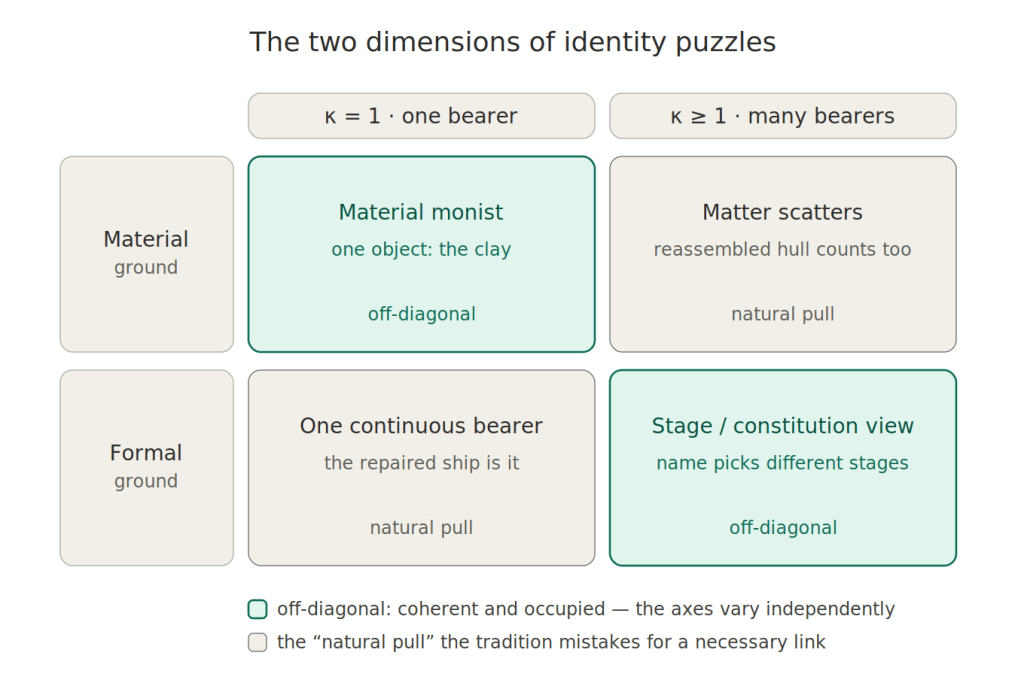
I grant the observation and deny the entailment. First, the strength of the denial, since it bears real weight: by “coherent and occupied” I mean the modest thing the structural argument needs and no more—each combination is logically consistent, can be extended into a full position without collapse, and is not ruled out by the puzzle itself. I do not claim each is a standing metaphysical possibility; that would require the conflict of grounds to be unsettled, which I have not argued (§2, §7). The cells are rationally adoptable, not certified live—and that is enough to block the slide from natural pairing to logical dependence. There is a natural pairing in each puzzle—form pulls toward a single bearer, matter toward tolerance of plurality; constitution-pluralism is the view that keeps both objects. But a natural pairing is a defeasible tendency, not a logical dependence, and the off-diagonal positions are coherent and occupied in just that calibrated sense:
- A material theorist can be a strict monist: “the only object here is the clay; the statue is a phase of it; there is exactly one bearer.” The monist’s denial of a second candidate is not a retreat from the material criterion but exactly the cardinality move—matter still settles identity; the dial that has turned is the count, set to one. Material ground, single bearer.
- A formal theorist can be permissive about bearers without abandoning the formal criterion. A stage theorist holds that the name picks out different temporal stages in different contexts, so “the Ship of Theseus” may denote distinct stage-bearers under one and the same formal account of what unites a career. I concede this is the contested cell: stage theory fragments the career temporally, which can look like building permissiveness into the ground itself. So pair it with a plainer case that does not—a contextualist who holds a single formal criterion of what unifies a ship’s career, yet lets “the Ship of Theseus” pick out different admissible careers across registry, museum, and salvage contexts. The criterion of career-unity is fixed; the number of admissible bearers is not. Formal ground, many bearers.
All four cells of {material, formal} × {one bearer, more than one} are inhabitable in both puzzles. The criterion fixes which truth-maker settles identity; it does not fix how many things the situation contains. Those are answers to different questions, and a position on the first does not entail a position on the second. The objector has detected the gravitational pull between certain pairings and mistaken it for a chain.
That the pull is real is itself worth recording, because it explains the whole history. It is why the dependence looks compulsory, and why the second dimension has stayed invisible: the typical theorist slides from criterion to matching cardinality without noticing a second choice was made. Making it visible, and showing it unforced, is the contribution—and everything in §5 is an application of it.
5. The cases as instances of the matrix
With the two dimensions separated, the canonical versions stop looking like one problem at different difficulties and resolve into different structures, distinguished by where the cardinality question falls.
5.1 Plutarch: one candidate, cardinality does not yet arise
In Plutarch’s version—gradual replacement, nothing reassembled—there is a single candidate object, the one hull. The two criteria are brought to bear on it and disagree about whether identity is preserved: both answer does this object persist?, the material criterion No, the formal Yes. This is a dispute over the predication of identity to one object. A reasoner cannot consistently assert both verdicts—they are contradictory, and I do not claim one mind holds both in peace. The structural point is that each criterion, by itself, delivers a consistent verdict on the one candidate, and the disagreement is between two such self-consistent positions a community may occupy. That is how Plutarch reports it: one school against another, the ship sailing on under both descriptions in the city’s mouth if not in any one head. The verdicts are not jointly true; they are jointly maintained, as rival positions, by a community that has not fixed a criterion. Strictly, this is not a case free of cardinality but the limiting case where cardinality cannot toggle anything: the candidate set has size one, so any assignment—unique or permissive—yields the same verdict structure, the criteria contradicting each other over that one object. (One might object that “one hull” is already a count—that a material theorist could see two objects, the original and its gradual replacement. Granted; but that pushes the individuation of candidates upstream of the dispute, and wherever the set is fixed at one, the count is inert.) What keeps this a genuine puzzle rather than mere disagreement between theories is the shared background expectation of a single fact of the matter—numerical identity is singular—so the two self-consistent verdicts press toward one answer the case does not supply.
5.2 Hobbes: cardinality at the level of reference
In Hobbes’s version—the discarded planks saved and reassembled into a second hull—the structure changes, and not because the criteria change. The same two criteria are in play, but there are now two candidate objects, and the criteria pick out different ones: the material criterion points to the reassembled Piraean hull, the formal criterion to the continuously repaired Aegean hull. The question is no longer does this one persist? but which of these two is the referent of the name? The dispute has migrated from the predication of identity to one object to the reference of one name across two objects. Compressed: Plutarch varies a predicate over a fixed subject; Hobbes varies the subject under a fixed term.
This migration is the real difference between the versions, and the clean replacement for loose talk of “coexistence versus exclusion.” The reference-disagreement becomes a contradiction only when the Exclusion Principle’s assignment forces a single bearer. A tempting objection—that the single-bearer assignment is built into the very question—turns out to make the point. “Which is the ship?” does presuppose uniqueness; that is exactly why it forces exclusion. But “which things count as the ship?” presupposes no such thing, and is an equally admissible way to pose the puzzle. The uniqueness is therefore not in the world or in the criteria; it is in the form of the question, set before any answer is given. If the name’s reference may vary by context—the registry, salvage law, the museum, and sentiment each fixing it differently—both hulls may bear the name under different assignments, and the nominations no longer collide. Reassembly does not by itself produce exclusion; it produces a reference-dispute, and the cardinality assignment, smuggled in with the singular question, converts that dispute into exclusion. (This is why Hobbes himself feels no conflict: he selects a criterion and a single-bearer reading, and the exclusion is downstream of the latter—a stipulation at the origin, no more privileged than the verdict of the Athenians who took the other side.)
5.3 The statue and the clay: cardinality at the level of ontology
The same orthogonality reappears in a puzzle the case-by-case treatments file alongside Theseus, with the cardinality parameter relocated from a name to the ontology itself. Shape a lump of clay into a statue. The two seem to share all their matter and location, yet to differ in their persistence conditions—squash it and the lump survives while the statue does not. By the indiscernibility of identicals, differing in a property is differing in identity, and there appear to be two coincident objects where common sense saw one. (Gibbard’s Lumpl and Goliath are the canonical names; the constitution literature is the home of the problem.)
The criteria are the familiar pair: material persistence (identity tracks the clay) and formal persistence (identity tracks the statue-kind). The candidate bearers are the lump and the statue. But the free parameter here is not a constraint on a name; it is a constraint on object-count. The monist holds that exactly one object occupies the region; the constitution theorist holds that there are two coincident objects, the statue constituted by but not identical to the clay. The Exclusion Principle applies without alteration. Under monism—a single-object assignment—the two criteria cannot both come out true of the one object, which cannot both survive squashing and fail to, so a reasoner must privilege one persistence condition or deny the modal difference is real. Under the constitution view—a permissive assignment—the criteria run parallel: each true, the material of the lump, the formal of the statue, no collision.
This does more than replicate the ship. In Theseus the candidates are spatially distinct and share no matter at the moment of the puzzle, and the assignment falls on a name’s reference. In the statue/clay case the candidates are spatially coincident and share all their matter, and the assignment falls on how many objects there are. The parameter survives a change of level, from reference to ontology—which is what suggests it is structural rather than a quirk of how proper names work. The hidden free parameter is not “the semantics of names”; it is, more generally, “how many bearers the situation is allowed.” I flag here what the next section makes formal: that one parameter governs both a name’s referents and a region’s objects is a working hypothesis, not a result—the shared κ in the schema marks the bet, not its discharge.
5.4 A schema, and the one caution it makes visible
Let $C_m$ and $C_f$ be the material and formal criteria, each offered as sufficient in its own right to settle numerical identity. Let $\kappa$ be the cardinality the situation is allowed—the number of bearers a name may have, or objects a region may contain—with $\kappa = 1$ (unique) or $\kappa \geq 1$ (permissive).
- One candidate (Plutarch): $C_m$ and $C_f$ deliver contradictory predications of the single object $O$. The dispute is over predication; $\kappa$ does not yet arise.
- Two candidates (Hobbes: distinct hulls $O_1, O_2$; statue/clay: coincident $O_s, O_c$): $C_m$ and $C_f$ nominate different bearers. Under $\kappa = 1$ they cannot both be true—exclusion. Under $\kappa \geq 1$ each is true of its own bearer—parallel verdicts, no collision.
The criterion fixes the truth-maker; $\kappa$ fixes whether the criteria’s outputs collide; the two are set independently (§4).
The schema earns its place by making one caution unhideable. The variable $\kappa$ ranges over a name’s referents in the Hobbes case and over a region’s objects in the statue/clay case. Treating these as values of a single parameter is the paper’s unifying bet, not a proven identity. It may be that reference-cardinality and object-cardinality are one variable in two costumes, or two structurally analogous parameters that happen to toggle exclusion the same way. A decisive test would be a puzzle that crosses the axes—distinct candidates contested under a count noun rather than a name, or coincident candidates contested under a name—to see whether the toggle behaves identically across the crossing. What would a unification have to deliver, beyond this matching behaviour? A single constraint underwriting both domains—something like how many eligible bearers may simultaneously satisfy the competing criteria within one admissible interpretation of the situation. Short of that, the honest characterisation is two dials—one linguistic (how a name refers), one ontological (how matter occupies a region)—apparently wired to the same circuit: the schema exposes the circuit even if the dials prove distinct. A sharper test than mere matching, then: stage the crossing concretely—rival restorations competing for “the artwork” (distinct candidates under a count noun), or a single proper name over coincident objects—and watch whether the toggle from parallel verdicts to exclusion comes apart. If it holds, the unification gains; if it parts, κ was two dials all along. I record the unification as a commitment, not a result. What does not depend on it is already secured: in each puzzle taken on its own, the two dimensions are independent, and it is the cardinality answer, not the criterion, that decides the collision.
6. The prime exhibit: dissolution as conflation
The Ship of Theseus is most often offered as the clean case of a paradox that is really a confusion, dissolved by fixing the criterion. With the two dimensions in hand, that classification inverts: the standard dissolution is the clearest specimen of the conflation, not a counterexample to it.
Take the dissolution view in its strongest reconstructible form—and pin it on no proponent, because it needs none; it is the natural thing a careful person thinks, which is precisely the point. The surface of the puzzle is plank drift and threshold vagueness: genuinely conceptual hygiene, genuinely dissolvable. Fixing the criterion is a correct solution to that layer. But in the two-candidate versions, “fix the criterion” does two things at once and reports them as one. It answers the ground question (matter or form), and—because it poses the puzzle as “which one is the ship?”—it silently answers the cardinality question too (exactly one bearer). The flicker stops not because the metaphysics was resolved but because both dials were turned, and only one turn was acknowledged. A reader who has separated the dimensions can see the second dial move; a reader who has fused them sees a single, satisfying click.
A determined dissolutionist resists at the cardinality step: the uniqueness, they say, is not smuggled but built into the sortal—”ship” is a count noun that carries its own principle of individuation, so one ship is what the concept delivers, not a separate choice. This is the strongest reply, and notice that it concedes the architecture while contesting the freedom: it agrees a cardinality is being set and argues that the concept sets it. The rejoinder is that the permissive question—”which things count as the ship?”—is a legitimate use of the very same concept, not a change of subject, as registry, salvage law, and museum practice attest whenever they let the reassembled hull bear the name for their own purposes. Were uniqueness forced by the sortal, those practices would be talking about something other than ships; they are not. The single-bearer reading is thus one admissible setting of the count—defended, perhaps rightly, but not entailed—which is all the argument needs.
This is why the charge bites for this puzzle in particular rather than against conceptual analysis in general. Ordinary analysis removes an inconsistency by the argued privilege of one ground over another and rests its verdict on those reasons. The dissolution treatment, in its most common presentation, removes it by stipulation—offering no reason to prefer matter to form—and presents the disappearance of the flicker, a consequence of having fixed either ground and a single bearer, as though no metaphysical question remained. It is not the choosing that is illicit; it is dressing two unargued choices as one dissolution that needs no choosing. And the reason this has gone unnoticed for twenty-five centuries is the very reasonableness of the move: a good answer to the wrong question is what survives. The disagreement that remains after the criterion is fixed is not a residue to be cleaned away. It is the metaphysics, still standing—now with its second dimension named.
The Ship of Theseus was never the puzzle that dissolves when you fix the frame. It is the puzzle that shows how fixing the frame conceals which ground you suppressed and—where there is more than one candidate bearer—which cardinality you assumed.
7. Two boundaries I hold
The thesis tempts two stronger claims. Naming why I decline them fixes its edges.
Against “practice defeats the material criterion.” One might say our practices of individuating ships—how registries, owners, and observers track “the same ship” across repair—do not merely favour the formal criterion but defeat the material one, eliminating rather than suppressing it. Distinguish two ways practice might bear on the metaphysics. On the first, our success in re-identifying objects is defeasible evidence about what identity consists in: a four-dimensionalist or stage theorist may reasonably hold that a metaphysics answerable to nothing in our practice is idle, and that the smoothness with which we track functional continuity is data. This is legitimate, and the paper is neutral on it. On the second reading, practice does not merely evidence the correct ground but constitutes or refutes it. That move I decline: how we find it useful to pick objects out is a fact about us; which truth-maker settles numerical identity is not, and the second cannot be read off the first without an argument I have not been given. The material criterion is therefore unchosen, not defeated—which is just to say the criteria remain in live conflict. Had practice defeated the material criterion, the Hobbes case would no longer host two genuine nominations and §5 would have nothing to carve.
Against “this is old philosophy in new clothes.” The strongest move against the paper is not a rebuttal but a reclassification, and a charitable critic will make it, because from where they stand it is largely true. None of this is new. The matter/form distinction is Aristotle’s; the reassembly variant and the preference for continuity are Hobbes’s; the statue and clay are the constitution theorists’; Locke and Hume and centuries of commentary have mapped this terrain. You have renamed known parts and called the renaming a discovery. That blow should land before the reply arrives, because it is mostly right—the criteria are ancient, the variants are not mine, the verdicts are taken. If the contribution were “there are two criteria for identity,” the critic would win outright.
The contribution is the second dimension and its independence from the first. The tradition names the two grounds and argues for one of them. What it does not supply is an account of why the versions and cousins are differently structured rather than the same problem at different difficulties—and the account requires a term the tradition lacks. “Form versus matter” operates one level below the joint; it has no term for cardinality and no term for the parameter that toggles it. All the cases deploy the identical pair of grounds; if the grounds were the whole story the cases would share a structure and differ only in felt difficulty. They do not share a structure—predication over one object, reference over two, count over one region—and in each the disagreement hardens into contradiction only under a cardinality assignment that is no part of either ground. I do not claim a metaphysical chasm between the cases. I claim a difference of structure in the dispute, plus a second, freely-set parameter the tradition silently welded to the first. To “you have merely relocated the problem into language”: I have not reduced the metaphysical conflict to a semantic one; the conflict of grounds is present and untouched in every version, and the cardinality assignment governs only whether it surfaces as a contradiction or as parallel verdicts—expression, not existence. To “you have solved nothing”: correct, by design; a reader who wants to be told which hull is Theseus’s is better served by the four-dimensionalist or hylomorphist attempts, which are genuine attempts at the verdict and are not ruled out here. But explaining why cases with identical grounds are differently structured is progress those partisan answers do not contain.
Remaining questions
Three remain, of three kinds. First, and most pressing, whether the cardinality parameter is genuinely one parameter or two structurally analogous ones (§5.4): the schema treats reference-cardinality (Hobbes) and object-cardinality (statue/clay) as values of a single variable, and the paper does not discharge this. A case crossing the two axes would test whether the toggle from parallel verdicts to exclusion behaves identically across the crossing, and so whether the unification is a result or a hopeful bridge. One tempting candidate disqualifies itself at the door, and saying why sharpens what the test requires. In Wheeler’s delayed-choice arrangement the choice of apparatus appears to set a count—interrogate which path and one definite history stands; interrogate the interference and both contribute—so the measurement seems to toggle κ in the strongest form the paper has met, the choice fixable after the quantum is already in flight. But the case supplies no two grounds each sufficient on its own to settle numerical identity while delivering contradictory verdicts on a single identity-claim: particle and wave are not rival truth-makers competing to fix persistence but mutually exclusive descriptions selected by a measurement basis, and this holds however one reads the quantum state—as the sole ontic item, as one among others, or as no thing at all—so the verdict takes no interpretation of the physics. The case thus tests κ alone, never the κ-and-ground joint the unification concerns; what it sharpens is the entry condition the genuine crossing tests must meet—two rival sufficient grounds—which the classical puzzles satisfy and the quantum mimic does not. Second, “which is the real one?” is not one question but a family, each indexed to a purpose—legal title, sentimental continuity, museological authenticity, material provenance—each potentially picking out a different bearer; its felt depth is underspecification, and it resolves on the same indexing that fixes the cardinality parameter. Third, whether identity is made true by constituent matter or by continuity of form is a conflict of grounds these puzzles do not settle; whether it is settleable at all, by other means, is a question on which this paper is deliberately silent.
*References. Plutarch, *Life of Theseus* (the original puzzle); Thomas Hobbes, De Corpore (1655), Part II, ch. 11 (the reassembly variant; Hobbes is standardly read as favouring the continuously repaired ship on grounds of continuity). The matter/form distinction and the privileging of formal over material continuity descend from Aristotle’s hylomorphism; the threshold worry connects to the Sorites; the four-dimensionalist response invoked in §2 belongs to the perdurantist tradition, the stage-theoretic variant to its stage-theory cousin; the statue/clay puzzle and the monist/constitution divide invoked in §5.3 belong to the literature on material constitution and coincident objects (Gibbard’s Lumpl and Goliath; Wiggins on constitution and sortal identity; the indiscernibility of identicals as the puzzle’s engine); and the treatment of the name as uniquely referring, with the contrast between rigid and descriptive routes to uniqueness, draws on the theory of reference in the tradition of Kripke’s Naming and Necessity.*

